The Big Red Stripe channel on YouTube has come great videos for filmmakers. I was watching The EXACT System Pros Use to Revise Their Screenplays where he goes through steps a professional screenplay writer may follow. My personal current interest is in writing scripts for episodes to produce using AI video generation (using ComfyUI in particular).
In summary the approach is:
- Draft 1: Get the “story” down on paper – is there enough there to be interesting?
- Draft 2 (the main focus of the video): Review the story so far, taking notes of various things you need to fix. Once you have collected all your notes, do the edits.
- Draft 3: Apply final polish.
In draft 2, the video goes into topics like worrying about budget for the production. What locations are you planning on when shooting in real life? How are you going to get the crew there, get exclusive access to the location to avoid onlookers, and more. Initially I thought “I am exploring AI for storytelling – I don’t have those expenses!” But then I thought a bit longer about where I spent my time. It still takes time and effort to create good backgrounds and locations, with shots from different angles. So while it may be cheaper, many of the points presented in the video are still relevant.
The important message to me however was professionals have repeatable methodologies they follow.
I am not a professional screenplay writer, but I am a professional software developer. At work, we believe it is important to follow the same methodologies across projects, because we have worked out common situations that go wrong and merged them into the methodology to avoid repeating the same problems on later projects. It’s not about having a perfect methodology that never changes — it’s about learning and adapting, incrementally improving the methodology over time. In software, new technologies are coming out all the time. Technologies to use on projects and new tools to use as developers, so a static methodology does not really make sense.
So I am now spending more time on planning projects, listing what I expect all the tasks to be in an episode up front. I am creating checklists – as a template to reuse across episodes, but customizable within an episode. I then define deadlines for lists of tasks for motivation. To be flexible, I am using Markdown for the checkpoint lists. I can add anything I need for a project.

I also added a special @deadline marker that keeps track of dates from the start of the checklist. They turn red if I miss the date, green when complete. Simple stuff, but enough to keep me focused.

I am starting with multiple checklists per episode. Checklists may be for fleshing out the overall plan, then writing the script, then researching tasks I don’t know how to achieve with AI yet, then finally generating the video. It allows me to overlap or interleave work for different episodes. For example I can schedule writing the script for the next episode before completing animation of the previous episode. It can help keep the work pipeline full.
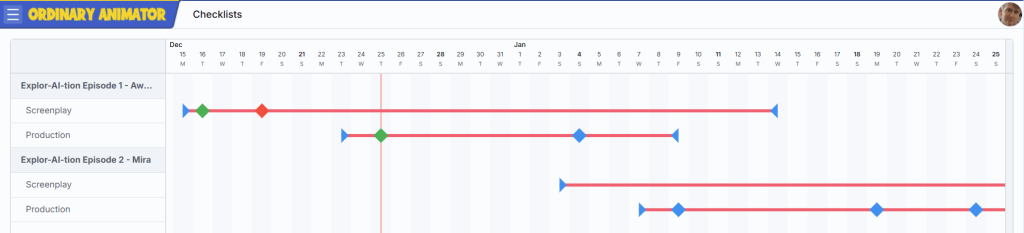
As I am doing my animation projects as a hobby in my free time, I am hoping the above will help me maintain focus. I am planning to be somewhat fine grain I can defines steps in terms of hours, deadlines in terms of days, and checklists maybe in terms of weeks. I then can get a frequent feeling of accomplishment in small steps, with a realistic expectation of how long it will take to complete the entire project. The I can iterate and improve the defines steps as I try to meet them.
 Extra Ordinary, the Series