
I sometimes listen in on the Academy Software Foundation (https://www.aswf.io/) sessions. The latest Web OpenUSD online meeting had a presentation by CloudZeta, OpenUSD for 3D Cloud – Content Distribution & Collaboration. 3D assets are large, so having a shared online storage area that 3D creators and consumers can share with web based preview would be a great tool for the ecosystem, as I shared in one of my previous articles. I loved that someone is giving this problem a go.
To summarize, with the continued demand for 3D content with VR headsets, AR experiences (web and native apps), and the latest buzz word of “Spatial Computing” with the new Apple Vision Pro headset, the need to collaborate on 3D assets is growing. OpenUSD (originally from Pixar) has been selected by Apple as the primary format for 3D content. Will the other older formats go away? No, but many tools are adding support for OpenUSD, making it a good choice for standardization of interchange.
How is this going to work in practice? I believe you will start seeing businesses deciding they want to build a first 3D experience, but they don’t have the internal 3D modeling skills. Instead, they will engage a specialist external service provider to create the assets, review them with the customer, and finally deliver them. But how to do the review? The assets are too big to email. So lots of large files need to be uploaded to the cloud, downloaded by the client, then the customer has to install viewing applications (like NVIDIA Omniverse USD Presenter) to open the files. It consumes lots of local disk space and messing around just to view a 3D model. Oh, you just made a change? Let me download that file again. Can you just email me? No? Oh, it’s too big. Oh, darn, I think I mixed up some of the old and new files. Now which parts changed in this release? I don’t think the tools we have today are going to make this an efficient process.
This is where projects like CloudZeta.com could help. Upload the assets to a 3D cloud, with access controls to limit who can access the resources, then let the customer open a web browser to preview the result. No big downloads, no local files to manage, no software to install, full version history available online.
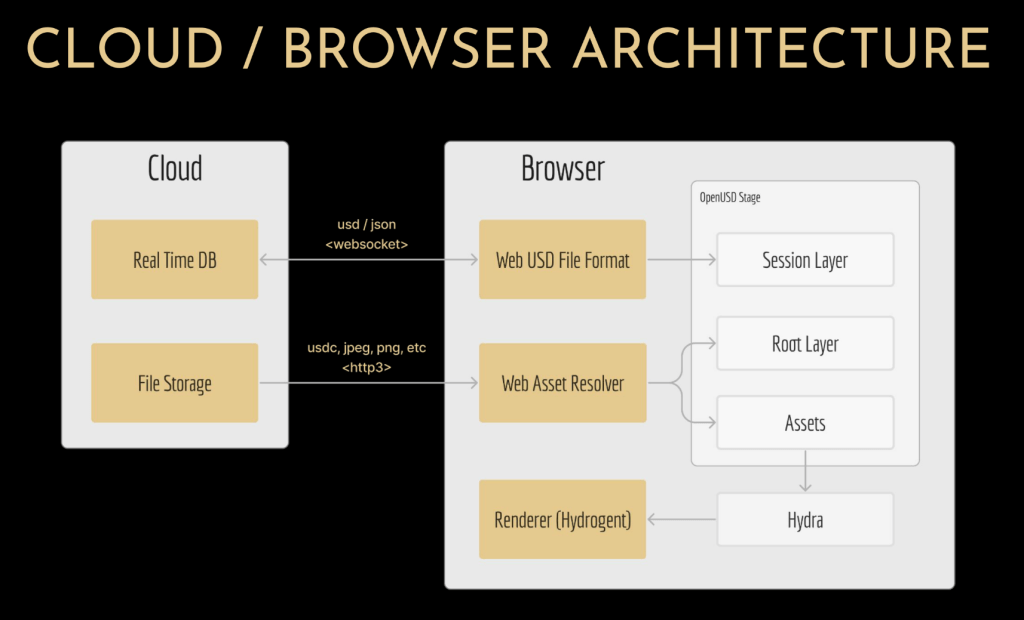
If the community can agree on the protocols to use (e.g., HTTP + authentication + URL structure conventions for versioning), then it can start to be included in all the tools directly. Omniverse already shows what this experience can be like with their Nucleus server for collaborative non-destructive editing. It feels great. Make a change and others can see it instantly. You can discuss and fix small problems live. Unfortunately, Nucleus is an internal enterprise product. I believe what is needed is an open product that is available to many independent companies. “The GitHub for 3D content.”
The CloudZeta presentation actually showed two nifty things. The first was their vision for shared cloud storage with preview, but the second was the Hydrogent project – an open source project for rendering USD in the web browser. It leverages projects like USD and MaterialX on the Web created by Autodesk.
As a side note, I have talked about “God Rays” a few times now, sunbeams coming through the clouds, so I loved seeing EpipolarLightScattering as the first post process listed.
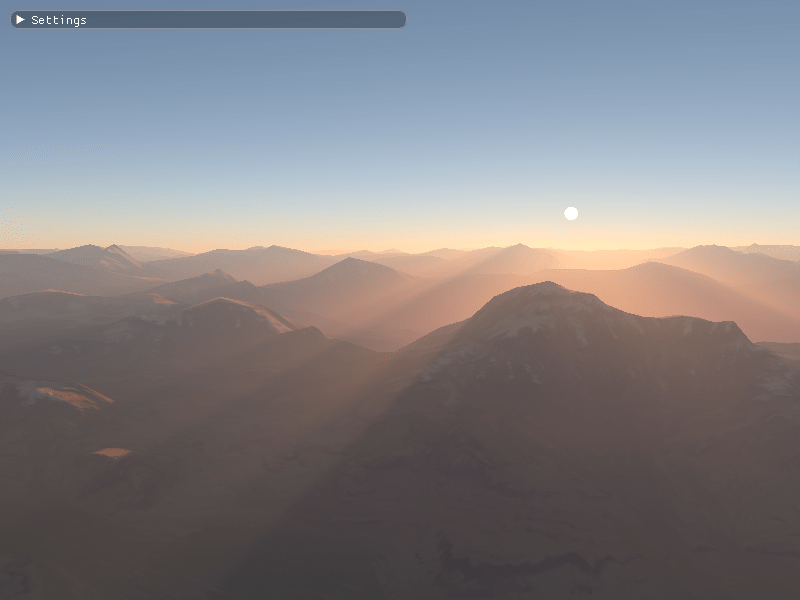
No, they don’t have many available yet (no Bloom for example), but I loved seeing the shot. It will be interesting to see how that project progresses.
For my own project, creating animated videos, I would love such a service too. I currently have to provide upload tools for all the assets myself. There are character models, props for use in scenes, location assets (buildings, rooms, etc.) – they all take up a lot of storage. My own desktop frequently fills its disk. Storing all that content in the cloud with a rendering solution that does not require downloading to my desktop would be a fantastic resource to take advantage of.
And if we can agree to various conventions, then all the other tools in the ecosystem can hook up to services like CloudZeta directly. No more sending files over to a rendering service – it can fetch the files directly from the shared cloud location by granting it permission to access my collections.
So I am looking forward to seeing how CloudZeta progresses.
 Extra Ordinary, the Series